


About the project
The AuScope VLBI project is a research collaboration between the University of Tasmania and Geoscience Australia.
It covers Australia’s contribution to the international network of geodetic radio observatories for Very Long Baseline Interferometry (VLBI), an essential piece in the Global Geodesy Supply Chain.
VLBI is a space-geodetic technique to measure the shape and orientation of the Earth. Radio telescopes use signals from extra galactic black holes as anchors, providing the most stable refence available in the Universe. This information is subsequently used to measure global distances to the level of a few millimetres, to precisely determine how fast the Earth rotates and to support precise orbit determination for satellite navigation and remote sensing missions.
Observatories
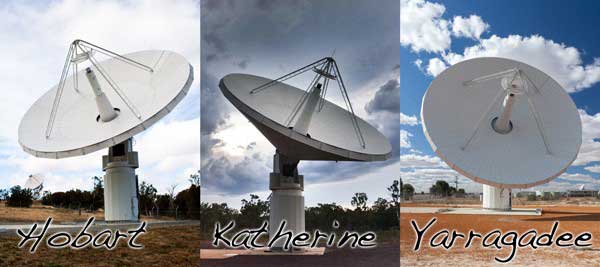
Our observatories are located at three sites across the Australian continent: at the Mt Pleasant Radio Observatory in Hobart, Tasmania; at Australia’s “Geodetic Supersite” Yarragadee in Western Australia and in Katherine at the Charles Darwin University campus in the Northern Territory. We have three identical 12m class telescopes. Initially, they were observing in the S/X legacy VLBI mode and over the past years they have been upgraded to VGOS capability.
Our team
Featured stories
- Geoscience Australia - A true partnership to improve position, navigation and timing services in Australia
Published: 17 July 2023 - UAV Photogrammetry for Precise Radio Telescope Calibration (phaseone.com)
Contact us


Postal address
AuScope
University of Tasmania
School of Physical Sciences
Private Bag 37
Hobart Tasmania Australia 7001