

Project details
Status: Current
Project overview
The Tasmanian Institute of Agriculture (TIA) has been funded by the Tasmanian Government’s Agricultural Development Fund to develop a low-cost electronic nose (e-nose) that can detect biological activity in the soil related to changes in soil carbon. It can help farmers better understand on-farm carbon sequestration.
This project builds on two previous e-nose projects that were funded by the Cooperative Research Centre for High Performance Soils (Soil CRC). Previous work led to development of the QUOLL® which is a device that can detect many different gaseous compounds from the soil at the same time.
Express your interest in being a trial collaborator
We are seeking expressions of interest from Tasmanian farmers and land managers that would like to host a QUOLL® e-nose on their property. This is expected to commence in late 2024 and throughout 2025.
Please complete and submit the online form if you are interested in learning more about what having a QUOLL® visit your property will entail.
Alternatively, contact project lead Shane Powell directly to express your interest.
Email shane.powell@utas.edu.au or phone 03 6226 6286.
What is an e-nose?
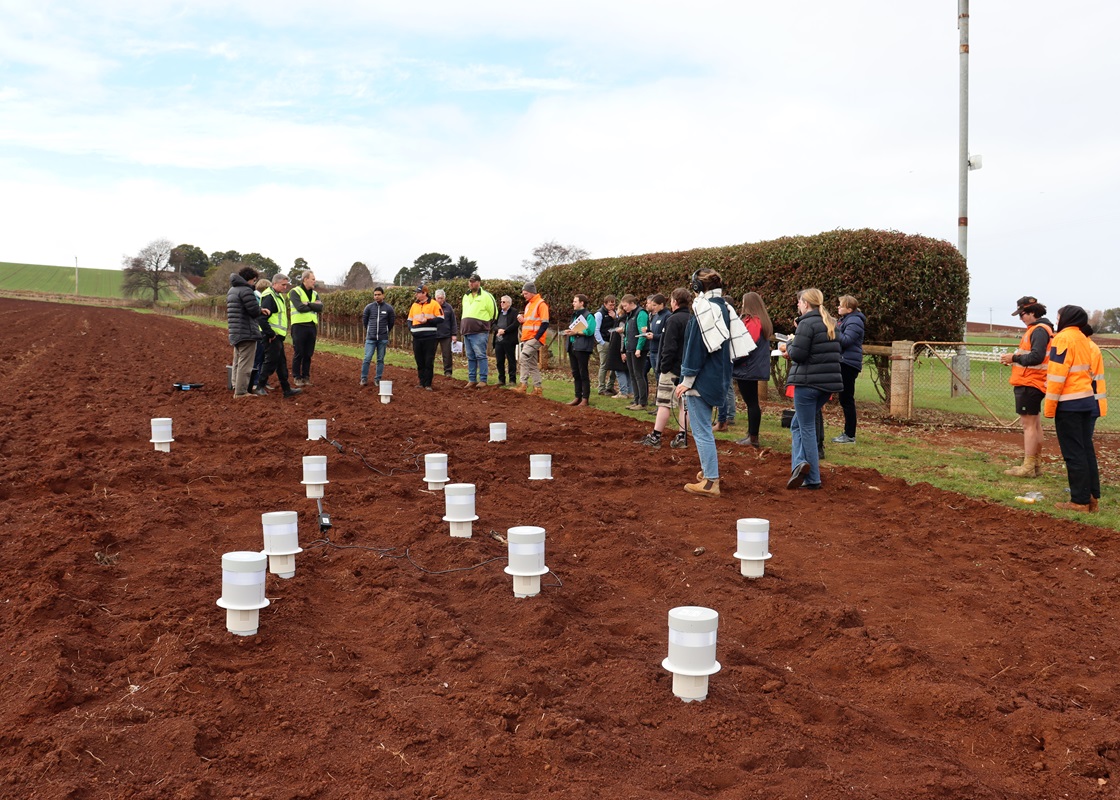
TIA researchers have developed an e-nose called a QUOLL® which sniffs the soil using a range of sensors that are sensitive to different gases and environmental conditions.
We wanted to find a faster, easier and cheaper way to understand what is happening in the soil at a biological level.
Plants, nematodes, fungi and bacteria all produce different compounds, and this device helps us to identify what they are doing in the soil. This provides us with important information that can help us make informed decisions about how to treat the soil.
“We’ve been developing an electronic nose called the QUOLL® that can detect the aroma of soil and provide a rapid test of soil activity. It can help farmers make informed decisions about how to best manage their soil and be more productive and resilient to environmental changes,” said Dr Simon Edwards, TIA Agricultural Research Engineer.
We’re looking for Tasmanian farmers to get involved by hosting a device on their property.
Field trials
During 2024, we will be deploying the QUOLL® e-nose on Tasmanian farms to find out how well the device can withstand farm conditions and test its ability to detect soil carbon dynamics.
Our aim is that the e-nose will provide farmers with a fast, easy and cost-effective way to monitor how their land management practices are changing the carbon in their soil.
Related stories
For more information contact:
Dr Shane Powell, Senior Lecturer In Microbiology, Agriculture and Food Systems at the Tasmanian Institute of Agriculture
+61 3 6226 6286
Acknowledgements:
This project is supported with funding from the Tasmanian Government through the Agricultural Development Fund.