

Project details
Status: Current
At a glance
- A major quality issue for the Australian carrot seed industry is damage caused by seed feeding Hemipteran insects including Rutherglen Bug (Nysius vinitor), Grey Cluster Bug (Nysius calendoniae) and the Australian Crop Mirid (Sidnia kinbergi).
- Current chemical strategies used to manage Hemipteran pests is thought to negatively impact pollinators and other beneficial insects.
- This project will develop integrated pest and pollinator management strategies for Hemipteran pests of carrot seed production.
About the project
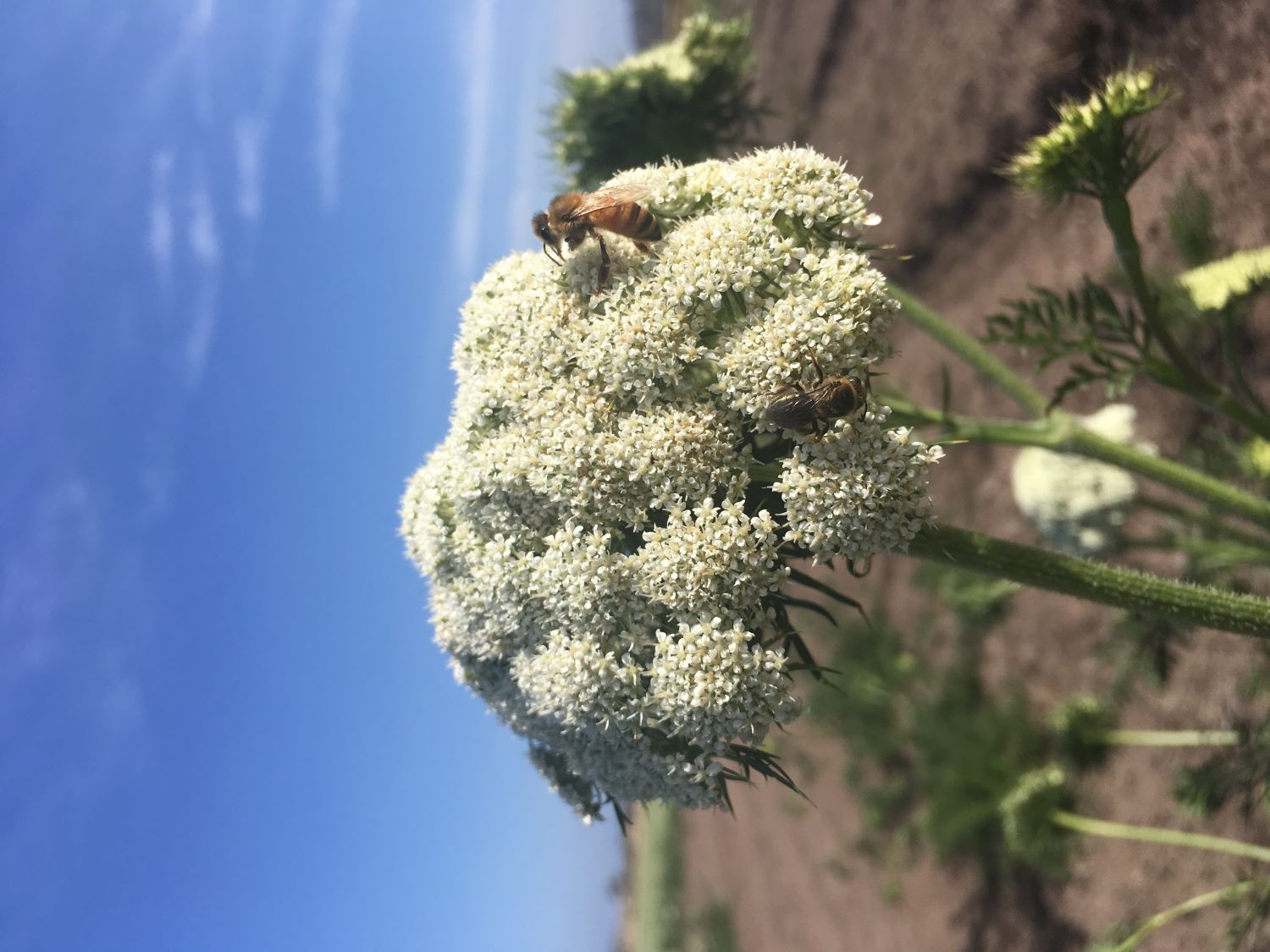
Damage caused by seed feeding Hemipteran insects is a major quality issue for the Australian carrot seed industry. Rutherglen Bug (Nysius vinitor), Gey Cluster Bug (Nysius calendoniae) and the Australian Crop Mirid (Sidnia kinbergi) are all known to damage to developing seed, with Rutherglen Bug being most important. Affected seed is unable to germinate and cannot be removed during seed processing. Effective pest management practices during crop production are therefore essential. The most critical period for control occurs during the overlapping stages of flowering and seed maturation.
Currently, management of these pests is almost entirely through crop monitoring and application of broad-spectrum synthetic pyrethroid insecticides when critical control thresholds are exceeded. While this strategy is deployed in a way that minimises impacts on commercial honeybees used for pollination, other beneficial insects (wild pollinators and biological control agents) appear to be negatively affected. With increasing awareness of the importance of wild pollinators and beneficial insects in agroecosystems, growing restrictions on pesticide usage in global seed markets and increasing demand for organic seed production, there is a need to integrate other more sustainable pest management options into the production system.
The research
This research will develop integrated pest and pollinator management (IPPM) strategies for carrot seed production by:
- Evaluating ‘soft’ and organic chemical options for management of Hemipteran pests and their impacts on beneficial insect populations in carrot seed crops.
- Evaluating deterrents to minimise incursion of Hemipteran pests into crops.
- Developing and evaluating light trapping techniques to intercept migratory flights into crops.
- Benchmarking wild beneficial and pest insect populations and carrot seed quality in different cropping systems (organic, IPM and conventional).
Industry outcomes
This research will provide following outcomes for the carrot seed industry
- New approaches to Hemipteran pest management in carrot seed crops.
- Development of an IPPM approach to Hemipteran pest management in carrot seed crops.
- Improved understanding of the diversity and abundance of beneficial insects in carrot seed crops and the impacts of conventional, IPPM and organic approaches to pest control on these.
Related stories
For more information contact:
Prof Alistair Gracie | alistair.gracie@utas.edu.au
Cameron Spurr | cspurr@seedpurity.com
Acknowledgements:
‘Sustainably growing horticulture value in cool climate Australia’ (AS20004) is funded through Frontiers developed by Hort Innovation, with coinvestment from the Tasmanian Institute of Agriculture, University of Tasmania, Simplot, Premium Fresh, Bejo, Potatoes New Zealand, The Scottish Society of Plant Research, Botanical Resources Australia, South Pacific Seeds and contributions from the Australian Government and contributions from the Australian Government.