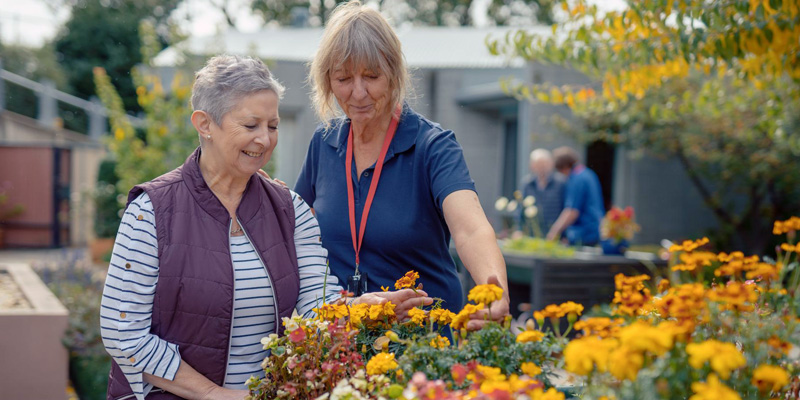
In 2022, the UTAS Centre for Rural Health (CRH) secured grant funding from the Department of Health Workforce Program – Expansion of the Rural Health Multidisciplinary Training (RHMT) Program in Aged Care Services. This funding facilitated the development of a multidisciplinary training site in partnership with Corumbene, an aged care facility located in New Norfolk. Launched in May 2024, the New Norfolk Rural Health Training site is located within Corumbene’s Health Hub.
The primary objective of the New Norfolk Rural Health Training site is to expand rural training opportunities for nursing and allied health students in Tasmania through a Work Integrated Learning (WIL) model. This initiative aims to drive workforce development, enhance health care delivery, to improve health outcomes in the community. Students from UTAS across nursing and allied health disciplines can now undertake innovative WIL experiences in the Derwent Valley region with place-based academic supports. They can also make use of the educational infrastructure at the rural health training site within the Health Hub.
Justifications
Social return on investment (SROI) has evolved from traditional cost-benefit analysis (CBA) to assess social value. Unlike conventional health economics methods, SROI is an evaluative framework that captures social value by measuring not only the financial returns of an intervention but also the aspects that significantly enhance stakeholders’ lives, such as improved physical development or reduced social isolation. SROI accounts for the social, economic and environmental values that can come as a result of an intervention or program. By working with the community coalition that has formed in the Derwent valley to support nursing and allied health learning experiences, SROI assigns financial proxy values to non-financial outcomes, providing a ratio that indicates the amount of social value generated for every $1 invested.
So far, only one SROI analysis has been conducted by James Cook university within RHMT program and a SROI protocol has also been published by Charles Sturt University.
The findings of this Tasmanian SROI will help quantify the longitudinal social, economic, and environmental benefits of the rural health training site, providing tangible evidence of the impact of these investments. Conducting an SROI evaluation also promotes accountability by demonstrating how resources are being used and the outcomes they generate, thereby building trust with the community and stakeholders.
Methods
This project will follow SROI principles which include involving stakeholders, understanding what changes, valuing the things that matter, only including what is material, not overclaiming, being transparent and verifying the results. The SROI will combine the actual impact with the potential impact of the expanded RHMT Program in Aged Care Services. The actual (or evaluative) impact is the observed impact of the program within the specified time horizon (in this case 1 year). The potential (or forecast) impact is based on the value that will be created if the intended outcomes are achieved over the mid-point time horizon (in this case 5 years) and the total time horizon (in this case 10 years).
Data collection involves gathering programme outputs, programme costs and conducting surveys and interviews with students, host organisations, supervisors and community members. The SROI will quantify the ‘investment’ required to implement the RHMT program, the New Norfolk Rural Health Training Site, as well as the ‘social return’ on the RHMT programme from the perspectives of students, organisations, supervisors and community.
Researcher/s
The evaluation team includes:

